

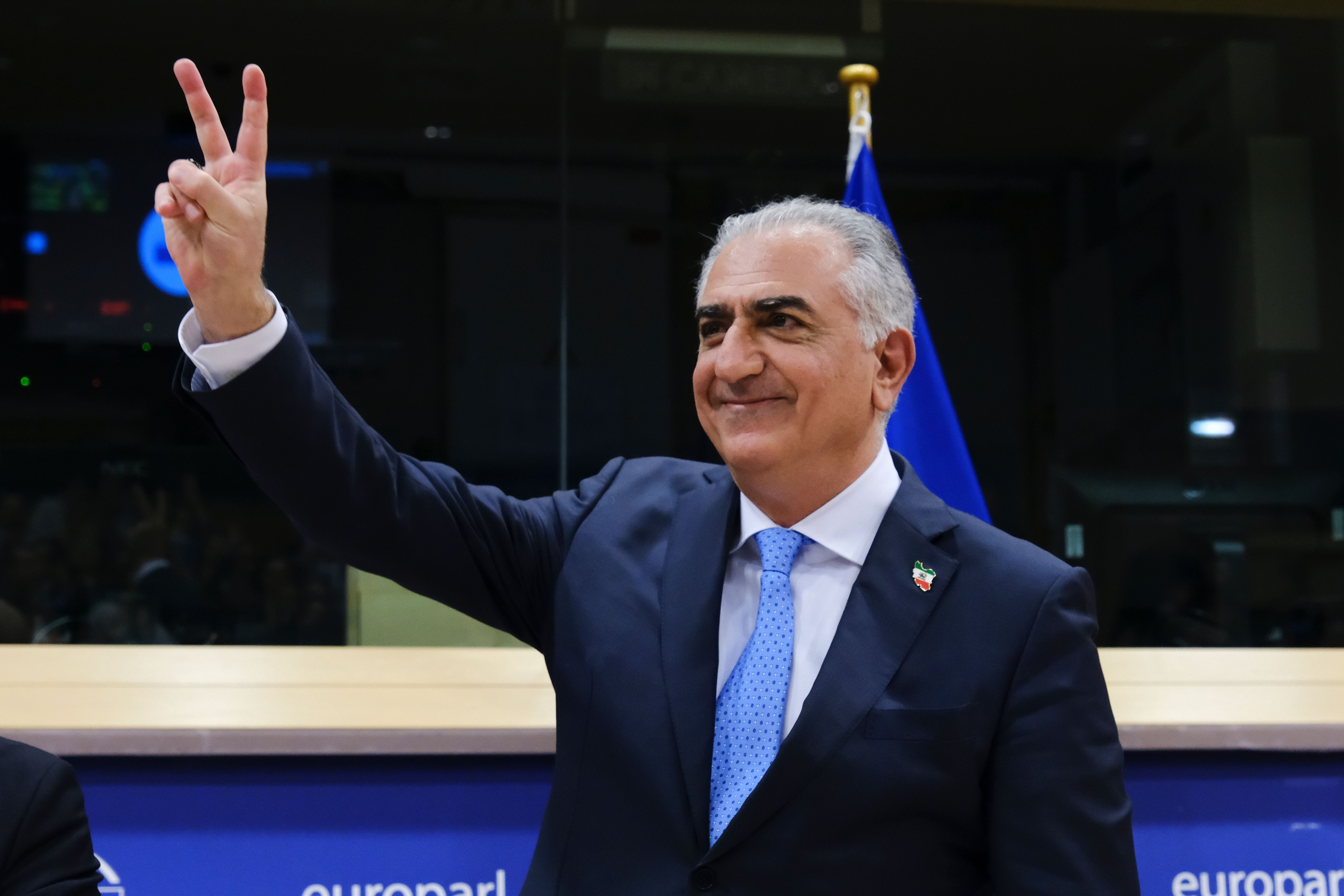
Reza Pahlavi
As of January 11, mainstream media continue to report protest fatalities in the hundreds; those tracking Iranian feeds describe something else entirely: mass killings under cover of night, likely in the thousands, fed by summary executions. In that gap is the story.
Early hopes that the Islamic Republic might collapse quickly, in the manner of Syria, suddenly seem particularly wishful (see previous post). There have been no senior regime defections, and the IRGC (Islamic Revolutionary Guard Corps, an arm of the Iranian armed forces created to defend the Iranian Republic) is treating this as indeed a “final battle”—which has been part of the protesters’ own chants. It is very possible that, as reportedly occurred during the Israel-Iran conflict last June, the IRGC has sidelined Khamenei. For the vast majority of Iran’s professional military, retaining control is not an elective, but a matter of physical survival.
Trump’s Catch-22
President Trump has warned Iran’s leaders: “If Iran shoots and violently kills peaceful protesters… the United States of America will come to their rescue. We are locked and loaded and ready to go.” That point has come and gone. The longer the delay between Trump’s commitment and action, the more the United States will, ironically, reinforce the Iranian view of America as fundamentally unreliable, with the historic sin being one of unlawful intervention. Now it’s abandonment. Critics of President Obama’s policies, which allowed Iran to expand support for its regional proxies, at least never promised support he failed to deliver. And at this point, there is no single act or concession from inside or outside Iran that could push either side to step back. It’s not even clear there’s anyone to negotiate with, on either side—the regime, or the people.
Three Scenarios
The current regime is, for practical purposes, over. But even if the rest of its trappings fall, what comes after is likely to be messy. Here are three possible scenarios, not in any order:
Scenario 1 has been called “Syrianization”: factional strife, militia competition, dissociation, all under a weak center. Iran is not Syria, as Iranians will insist, unified by ties to a great civilization. But humans are human.
Scenario 2: Rule by the military. The IRGC eclipses the clergy to rule directly or indirectly as “guardians of national unity,” transforming Iran into a secular praetorian state, defined less by ideology than by generals. These hypothetical outcomes have been described by Iran expert Karim Sadjadpour of the Carnegie Endowment. In a variant, an Iranian strongman, perhaps an alum of the IRGC or the intelligence services, emerges to discard Shiite ideology in favor of grievance-driven Iranian nationalism as the organizing creed of a new authoritarian order. This outcome may be the bleakest, for Iranians, and the world at large.
Scenario 3: restoration. This is by far the most optimistic of foreseeable outcomes: Reza Pahlavi, son of the former Shah, returns from exile to reinstate a constitutional monarchy. The longer and deeper the violence, the less likely this script matches the ecstatic public welcome Ayatollah Khomeini received when he returned from exile two weeks after the Shah fled in 1979. Nearly fifty years in exile has eroded Pahlavi’s memory—even among the estimated 30% of Iranians who remember the monarchy favorably. If Pahlavi were to return, he would likely need military support, but from whom? The United States? Hardly likely, even were an offer made. We’re acquiring restoration projects at too great a rate. This scenario, in other words, gets messier by the week.
How We Got Here
It is worth remembering the geopolitical context in which these developments are taking place. While the immediate trigger for the current uprising was acute economic crisis, induced by a mix of corruption and mismanagement, and crippling international sanctions, the game changer was the 2023 Hamas attack on Israel—the extent of its success, and the blowback it would trigger, were not anticipated by the regime.
Iran’s investment in regional proxies was not addressed by the 2015 Iran Deal, which focused narrowly on the nuclear question—leaving those networks to metastasize. Iran’s substantial military support (along with Qatar’s support for Hamas’ Gaza infrastructure) made the October 7 attack on Israel possible. That, in turn, combined with Israeli Prime Minister Netanyahu’s own personal/political quandary (related to internal corruption charges, also linked to Qatar)), set in motion the Israeli invasion of Gaza, and the subjugation of yet another population to the brutal whims of external governments.
In short order, Israel deflated Iran’s “Axis of Resistance” one by one—Hezbollah, Hamas, the Houthis, albeit seemingly with no larger regional strategy than to secure his own powers, in the face of a humanitarian disaster in Gaza. In this context, the Trump administration joined to attack Iran’s nuclear facilities. All of this, and the Iranian regime’s staged, weak retaliation against US troops in Qatar, exposed the regime’s deep weakness to its own people.
Like the 2.2 million Palestinians in Gaza, the Iranian people are paying a deep cost for multi-party political folly—trapped between their own brutal leaders and external powers without the will, or the means to save them.
The Middle East-Told Slant offers a non-partisan, practitioner’s perspective on Middle East politics, conflict, and culture. Written by a former US diplomat with 25+ years of regional experience, author of “Benghazi: A New History“ (Hachette, 2022) and Exit the Colonel (Public Affairs, 2008), and Translating Libya (Darf, 2015). Each week, I share analysis on current events, historical context, and cultural insights from the region, drawing on my experience in government, business, and academia across the Middle East.
To receive weekly posts and support independent journalism on the Middle East, consider becoming a free or paid subscriber. Paid subscribers receive a complimentary copy of any of my books (a value equal to the annual subscription — DM me to redeem).
I wonder how the current drought in Iran factors into this. While the direct impact to city dwellers may be minimal (lowered water pressure and other water saving strategies), I’ve read that roughly 45% of the country’s villages have been abandoned with their inhabitants becoming urban refugees. That affects the quality of life for the urbanites who are protesting.
It also presents a massive problem for whoever rules Iran in the future, regardless of whether it’s the clerics, the military, or some reconstitution of the Peacock Throne. The drought itself is something that is in the hands of Allah, but the government’s water management policies intended to make the country self-sustaining agriculturally have compounded it.
A lack of political freedom may generate unrest, but a lack of water is a threat to life itself.
Based on Mark’s insight and your reply to it, I think, on a larger level, how much climate change is looming as great a factor as economic instability in these regional unrests, and how intertwined they are becoming the more that efforts to deal with climate change keep getting stymied. We have solutions and measures, but still a paucity of imagination and will in seeing the connections.